Roberta Annan
Accra, Ghana · Based in Accra

“Jollof is just the beginning. Ghanaian food has depth that the world hasn't tasted yet.”
The tasting menu at Chef Roberta Annan's restaurant in East Legon begins with a single spoonful of groundnut soup, and by the time that spoon reaches your mouth, you understand that something extraordinary is happening. The soup is recognizable — the deep, nutty richness, the warmth of ginger and chili — but it has been refined to an almost ethereal clarity. A whisper of truffle oil floats on the surface. The garnish is a crisp of yam so thin it shatters at a breath. It tastes like home and like nowhere you have ever been, simultaneously.
"I am not trying to improve Ghanaian food," Roberta says, standing in her open kitchen in chef's whites, surrounded by the controlled intensity of a dinner service. "Ghanaian food is already perfect. What I am doing is giving it a stage. A spotlight. The respect it has always deserved."
Roberta's path to this kitchen wound through some of the most celebrated culinary institutions in the world. She trained in Paris at Le Cordon Bleu, then worked under a Michelin-starred chef in Lyon for three years. She learned French technique — the mother sauces, the precision, the obsessive attention to plating and texture. But even in the finest kitchens in France, she found herself thinking about her grandmother's kitchen in Tema. About the smoky depth of shito. About the alchemy of fermenting cassava into the sour tang of banku. About how the women in her family could balance five flavors in a single pot without ever measuring a thing.
"French cooking taught me discipline," she says. "Ghanaian cooking taught me soul. I came home to put them together."
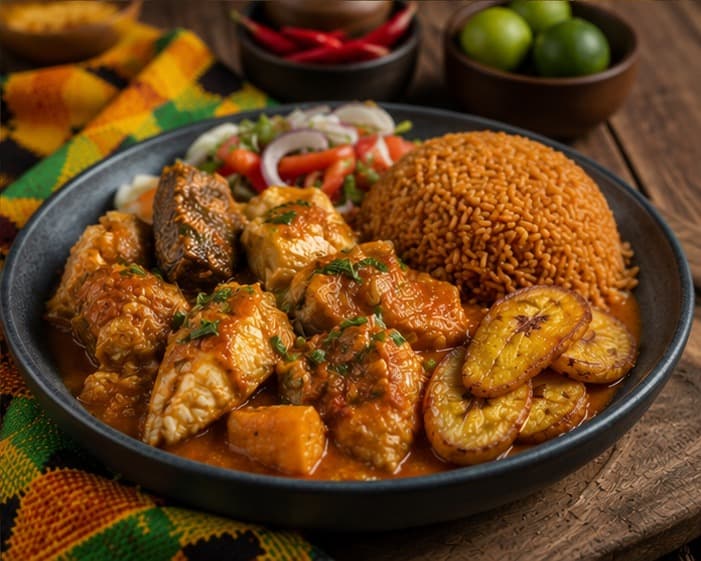
The restaurant's menu is a journey through Ghana's regions. There is jollof rice reimagined with smoked shito oil, the grains perfectly separated, each one carrying a complexity that unfolds on the tongue. There is kelewele — the beloved spiced fried plantain — served as a dessert, paired with vanilla bean ice cream and a drizzle of honey from bees in the Volta Region. There is a red-red course where the black-eyed beans have been slow-cooked for hours and the plantain arrives as a delicate crisp balanced on top. Every dish is a conversation between tradition and innovation, and tradition always has the last word.
Roberta sources obsessively from local farmers. Her tomatoes come from a family farm in the Volta Region. Her shea butter — used in several dishes — comes from a cooperative in the north. Her fish is fresh from Elmina. She visits her suppliers personally, often driving hours to inspect a crop or taste a new harvest. "If the ingredients are not excellent, nothing I do in this kitchen matters," she says. "Ghana's soil produces extraordinary food. My job is to not mess it up."
The debate about whether fine dining and traditional food can coexist is one Roberta has heard many times, and she has little patience for it. "People say, 'You can't put truffle in groundnut soup.' Why not? Groundnut soup is one of the most sophisticated dishes in the world. It stands beside anything in the French canon. The question is not whether Ghanaian food belongs in fine dining. The question is why it took this long for fine dining to catch up."
On a busy Saturday evening, the restaurant is full. Couples, families, visiting diplomats, young professionals celebrating promotions. The room hums with the particular energy of people who are eating something that moves them. Roberta watches from the kitchen pass, adjusting a plate here, tasting a sauce there, conducting the evening with the calm authority of someone who knows exactly what she is doing.
"Ghanaian food doesn't need saving," she says, sending out the final course of the night. "It needs a stage."
Browse verified tours or tell us what you want — we’ll build it.